The cabin boy who never went back on the water
A coin in the hand
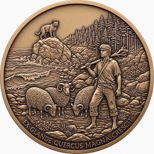

The Oak family has a challenge coin. It is a modern keepsake, made for relatives, and everything on it comes from one old family story.
One side shows a young man with a pine knot over his shoulder. A wildcat stands on a rock above him, two sheep graze at his feet, waves break on one side and New England pines rise on the other. Along the bottom runs a Latin motto, Ex glande quercus magna crescit: "From the acorn the mighty oak grows." The other side reads "American Acorns" above an acorn in its oak leaves, with "Est. 1660" and the three spellings Oak, Oaks and Oakes. The design notes add a rope edge for the sea voyage.
What the symbols stand for
Each picture on the coin stands for a piece of the story below:
- The waves: a shipwreck nine miles from land, on a ship bound for Boston, with one survivor.
- The pine knot and the pines: the pitch-pine forest where he was put to work, and the weapon he grabbed there.
- The wildcat: the catamount that attacked him, and the bounty paid for its pelt.
- The sheep: what he bought with that bounty, and all he owned when he came of age.
- The acorn and the three spellings: a family that started with one man and wrote its name in several ways. The records also show Oake and Oke.
The coin is a symbol, not a source. A few of its details are estimates rather than facts any record gives. The "Est. 1660" on the back, for example, rests on a 1906 guess at when he arrived. What follows sets out what the family said, what the records show and where the trail stops.
The story the family told
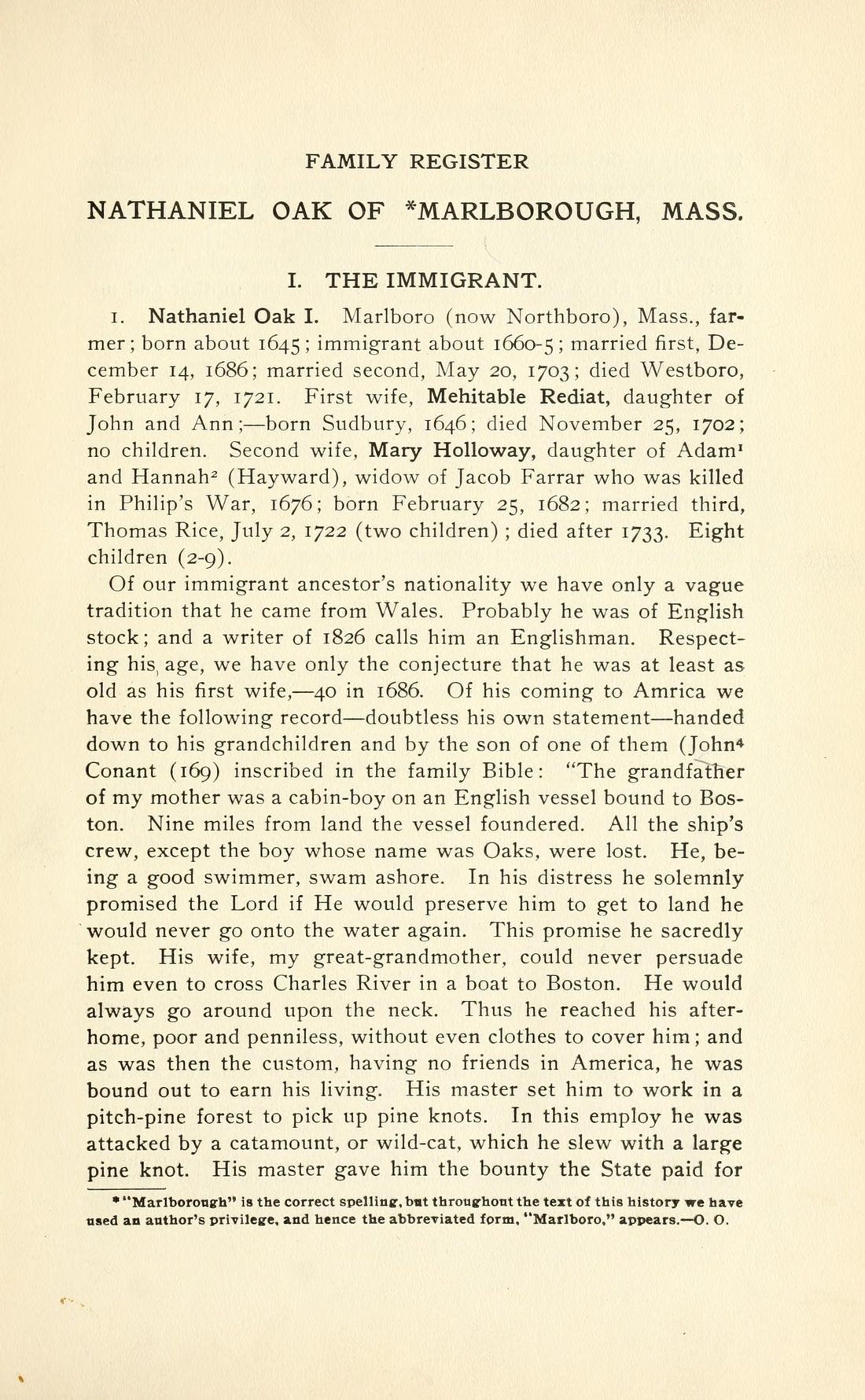
The family register compiled by Henry Lebbeus Oak, a kinsman, appeared in 1906. Its first pages print an account attributed to an inscription in a family Bible by John Conant, a great-grandson of Nathaniel born in 1773. Tradition
The account says Nathaniel was a cabin boy on an English ship bound for Boston. Nine miles from land the ship went down, and the whole crew was lost except the boy. He swam ashore. While he swam he promised God that if he reached land he would never go on the water again, and he kept that promise: his wife could not even get him into a boat to cross the Charles River to Boston. He walked around by the neck instead.
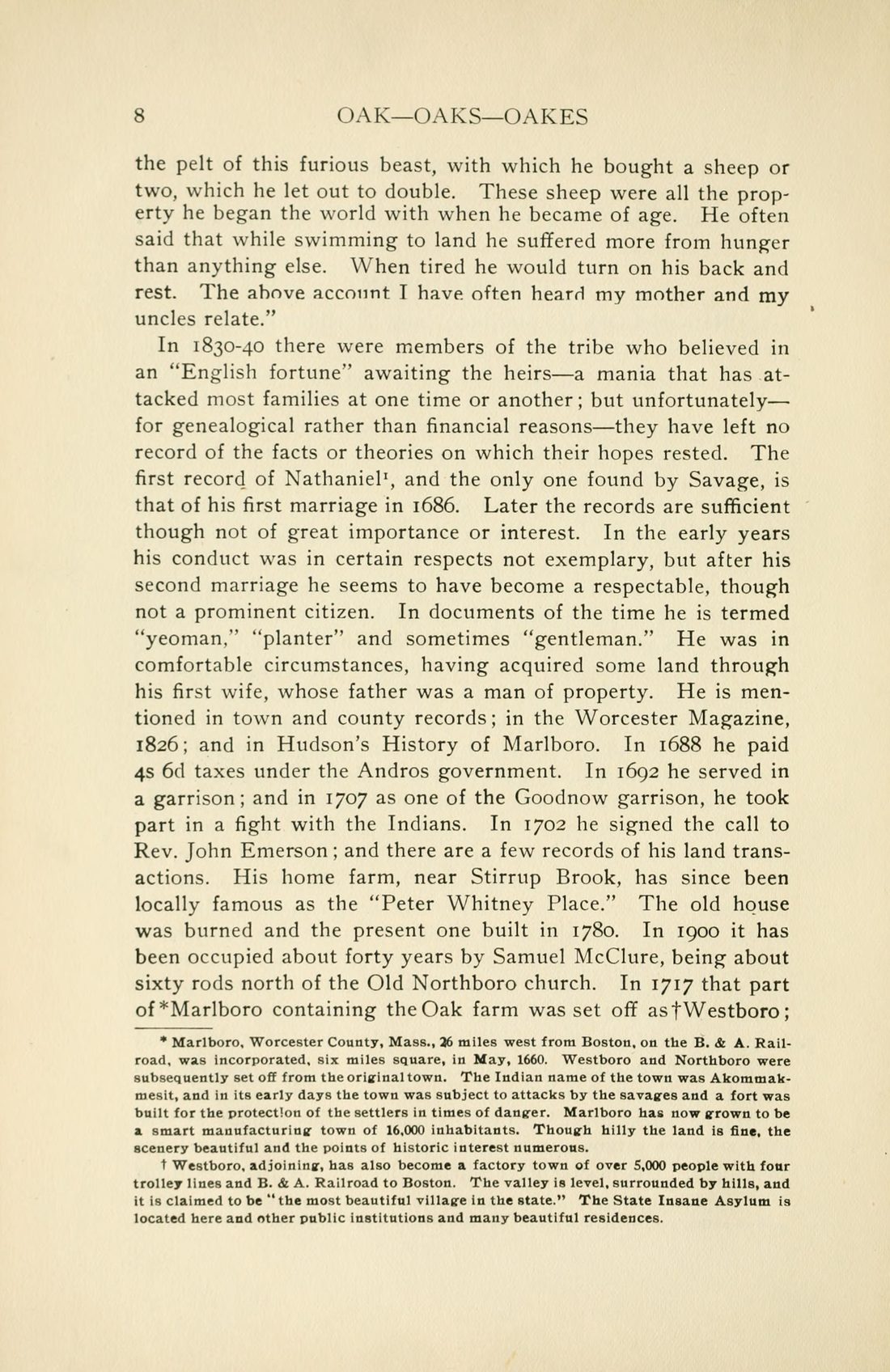
He came ashore with nothing, "without even clothes to cover him," and with no friends in America he was bound out to work. His master sent him into a pitch-pine forest to gather pine knots. There a catamount attacked him, and he killed it with a pine knot. His master gave him the bounty paid for the pelt. The boy bought a sheep or two with it and let them out to double, and those sheep were all he had when he came of age. He used to say that on the long swim he suffered more from hunger than from anything else, and that when he got tired he turned on his back and rested.
John Conant ended the account with a line worth keeping in view: "The above account I have often heard my mother and my uncles relate." It is family memory, two or three generations removed from the man it describes.
How far the story can be trusted
- What we have is a printed copy. The 1906 register is the earliest version of this story that has actually been inspected. That does not make it the earliest version that ever existed. Tradition
- This research has not located the Bible. It has not seen the inscription, so it cannot say who wrote it, when, or whether it was copied accurately.
- A separate lead, not established as the same object. Two nineteenth-century books describe a volume inscribed "Ebenezer Conant, his book, Ashburnham, Jan. 15, 1782," said to hold Ebenezer's writing and about a hundred autobiographical pages by his son John Conant. This research has not read it and does not know whether it mentions Nathaniel, so it is a lead, not a source.
- Two other traditions disagree on details. An 1826 writer called Nathaniel an Englishman, and the 1906 compiler mentions "a vague tradition that he came from Wales" before deciding he was probably of English stock. Neither names a town. Tradition
None of this shows the story is false, and missing records do not make it true. It should be told as the family told it, and not as something a record proves.
What the records do show
The earliest record of Nathaniel found in this research is his marriage in 1686 to Mehitable Rediat of Sudbury. Probable The 1906 compiler, who searched for years with hired help, found nothing earlier.
After that he is easier to follow. He farmed at Marlborough in the part later set off as Westborough and Northborough. He served in a garrison in 1692, and in 1707, as one of the Goodnow garrison, he took part in a fight with Native Americans, according to the 1906 register. Probable Mehitable died in 1702 without children, and in 1703 he married Mary Holloway. Sources disagree on the day. Probable They had eight children, among them a son John, born in March 1715. Documented Nathaniel died by 1722, when his estate went to probate and a guardian was named for young John "of Westborough." Probable
From John, whose identification with the John Oak of Westborough is probable rather than proven Probable, the line runs through a Revolutionary War soldier, also named Nathaniel, who marched on the Lexington alarm in April 1775 and, at 87, moved to Maine to spend his last days with a son. Their profiles carry the details and the evidence for each link, and the family tree shows how they connect.
Where the trail stops
The records examined in this research have not established Nathaniel's birth date, birthplace, ship, arrival or parents. Unknown The 1906 compiler guessed he was born about 1645 and arrived about 1660 to 1665. Those are estimates, and the children he fathered as late as about 1720 suggest he may have been born later.
Many online family trees give him parents named John Oakes and Elizabeth Harrison of Staffordshire, England. That claim traces back to a single unsourced tree entry from 2010 that was copied from site to site. It even places his supposed mother in Massachusetts towns before those towns existed. We do not use it.
Open leads (not being pursued now)
A few archives may hold the letters the 1906 compiler received, and an 1876 Vermont newspaper may have printed an earlier version of the family story. These are catalogued leads only. This research has not read them, and nothing has been ordered or requested.
Sources
- H. L. Oak, Oak-Oaks-Oakes: Family Register: Nathaniel Oak of Marlborough, Mass., and Three Generations of His Descendants (Los Angeles, 1906), pp. 7-8. archive.org/details/oakoaksoakesfami00oakh. Pages 7 and 8 are shown above.
- Vital Records of Marlborough, Massachusetts, to the End of the Year 1849 (printed), p. 142. Citation only; no item URL is recorded in the packet.
- Worcester Magazine, vol. 2 (1826), p. 152. archive.org/details/worcestermagazi00unkngoog
- Charles Hudson, History of the Town of Marlborough (1862), p. 426. archive.org/details/historyoftownofm00huds
- Middlesex County, Mass., probate case 16185 (1722), index. Citation only.