 American Acorns
The South Channel dam rescue: Irving Gilbert Oak
A story remembered in the family said that Irving Gilbert Oak, a lineman, once saved a man's life after an electrical accident. Maine newspapers of 1941 and 1942 confirm it.
The lineman
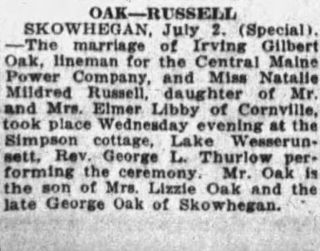
Irving Gilbert Oak was born in 1901. A 1925 marriage notice calls him a lineman for the Central Maine Power Company, and he was still one of the company's linemen at Skowhegan in 1941 and 1942. Confirmed
School and a first job
Unconfirmed evidence: show why
- He left school when he was 12 or 13. The age comes from the recollection alone. The 1940 census's fifth grade fits an early end to his schooling but does not show the age at which he left, and his birth date is recorded as both 23 and 25 August 1901 in the tree and as 1902 in census indexes.
- He went to work as a cook in a logging camp. No record found so far names a camp, an employer, a place or a season, or shows whether he was the cook or a cook's helper. His 1920 job on the electric railway neither confirms nor rules out earlier camp work.
- He went to work to help his mother with the younger children. The reason is the recollection's. The 1920 census does show younger brothers and sisters at home, and both parents in the household in 1910 and 1920, so the account should not be read as saying his father had died or left.
All the evidence for this recollection · What the labels mean
Confirmed evidence: show why
Why: The 1910 census of Skowhegan lists Irving G., son, 8, in his parents' household, marked as attending school (census image read on 25 September 2026).
Records:
- 1910 U.S. census, Skowhegan, Somerset County, Maine, ED 237, sheet 12B, lines 56-62: Irving G. Oak, son, 8, attending school. NARA T624, roll 546, page 12B; image held with the family tree (record page · view at Ancestry)
Review: assessed 09-25-2026; evidence: image inspected when the research was incorporated.
Likely evidence: show why
Why: The 1940 census records the fifth grade as the highest he completed, with the informant mark beside his own name (census image read on 25 September 2026). It is a single census answer; no school record has been searched.
Records:
- 1940 U.S. census, Skowhegan, Somerset County, Maine, ED 13-61, sheet 18A, line 15: Irving Oak, 38, lineman; highest grade completed, 5. NARA T627, roll 1492, page 18A; image held with the family tree (record page · view at Ancestry)
Review: assessed 09-25-2026; evidence: image inspected when the research was incorporated.
Confirmed evidence: show why
Why: The 1920 census of Skowhegan lists Irving, 18, son, not at school, occupation conductor, industry electric road (census image read on 25 September 2026). No employer is named.
Records:
- 1920 U.S. census, Skowhegan, Somerset County, Maine, ED 118, sheet 1A, lines 35-42: Irving Oak, son, 18, conductor, electric road. NARA T625, roll 648, page 1A; image held with the family tree (record page · view at Ancestry)
Review: assessed 09-25-2026; evidence: image inspected when the research was incorporated.
About this recollection 6 statements: 2 Confirmed, 1 Likely, 3 Unconfirmed
Where it comes from: A family member's recollection, written down in 2026. Who first told the story, and whether it came from the person it describes, is not recorded.
- Remembered He left school when he was 12 or 13.
Unconfirmed evidence: show why
Why: The age comes from the recollection alone. The 1940 census's fifth grade fits an early end to his schooling but does not show the age at which he left, and his birth date is recorded as both 23 and 25 August 1901 in the tree and as 1902 in census indexes.
Records:
- Family recollection: Irving Gilbert Oak's schooling and first job
- 1940 U.S. census, Skowhegan, Somerset County, Maine, ED 13-61, sheet 18A, line 15: Irving Oak, 38, lineman; highest grade completed, 5. NARA T627, roll 1492, page 18A; image held with the family tree (record page · view at Ancestry) (context)
- 1910 U.S. census, Skowhegan, Somerset County, Maine, ED 237, sheet 12B, lines 56-62: Irving G. Oak, son, 8, attending school. NARA T624, roll 546, page 12B; image held with the family tree (record page · view at Ancestry) (context)
Review: assessed 09-25-2026; no supporting record yet.
- Remembered He went to work as a cook in a logging camp.
Unconfirmed evidence: show why
Why: No record found so far names a camp, an employer, a place or a season, or shows whether he was the cook or a cook's helper. His 1920 job on the electric railway neither confirms nor rules out earlier camp work.
Records:
- Family recollection: Irving Gilbert Oak's schooling and first job
- 1920 U.S. census, Skowhegan, Somerset County, Maine, ED 118, sheet 1A, lines 35-42: Irving Oak, son, 18, conductor, electric road. NARA T625, roll 648, page 1A; image held with the family tree (record page · view at Ancestry) (context)
Review: assessed 09-25-2026; no supporting record yet.
- Remembered He went to work to help his mother with the younger children.
Unconfirmed evidence: show why
Why: The reason is the recollection's. The 1920 census does show younger brothers and sisters at home, and both parents in the household in 1910 and 1920, so the account should not be read as saying his father had died or left.
Records:
- Family recollection: Irving Gilbert Oak's schooling and first job
- 1910 U.S. census, Skowhegan, Somerset County, Maine, ED 237, sheet 12B, lines 56-62: Irving G. Oak, son, 8, attending school. NARA T624, roll 546, page 12B; image held with the family tree (record page · view at Ancestry) (context)
- 1920 U.S. census, Skowhegan, Somerset County, Maine, ED 118, sheet 1A, lines 35-42: Irving Oak, son, 18, conductor, electric road. NARA T625, roll 648, page 1A; image held with the family tree (record page · view at Ancestry) (context)
Review: assessed 09-25-2026; no supporting record yet.
- Records In 1910, aged eight, he was attending school.
Confirmed evidence: show why
Why: The 1910 census of Skowhegan lists Irving G., son, 8, in his parents' household, marked as attending school (census image read on 25 September 2026).
Records:
- 1910 U.S. census, Skowhegan, Somerset County, Maine, ED 237, sheet 12B, lines 56-62: Irving G. Oak, son, 8, attending school. NARA T624, roll 546, page 12B; image held with the family tree (record page · view at Ancestry)
Review: assessed 09-25-2026; evidence: image inspected when the research was incorporated.
- Records His formal schooling ended at about the fifth grade.
Likely evidence: show why
Why: The 1940 census records the fifth grade as the highest he completed, with the informant mark beside his own name (census image read on 25 September 2026). It is a single census answer; no school record has been searched.
Records:
- 1940 U.S. census, Skowhegan, Somerset County, Maine, ED 13-61, sheet 18A, line 15: Irving Oak, 38, lineman; highest grade completed, 5. NARA T627, roll 1492, page 18A; image held with the family tree (record page · view at Ancestry)
Review: assessed 09-25-2026; evidence: image inspected when the research was incorporated.
- Records In 1920, aged 18, he was a conductor on the electric railway.
Confirmed evidence: show why
Why: The 1920 census of Skowhegan lists Irving, 18, son, not at school, occupation conductor, industry electric road (census image read on 25 September 2026). No employer is named.
Records:
- 1920 U.S. census, Skowhegan, Somerset County, Maine, ED 118, sheet 1A, lines 35-42: Irving Oak, son, 18, conductor, electric road. NARA T625, roll 648, page 1A; image held with the family tree (record page · view at Ancestry)
Review: assessed 09-25-2026; evidence: image inspected when the research was incorporated.
Each statement has its own label. New research updates the labels, not the remembered words.
The rescue
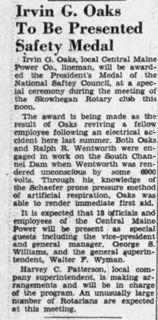
In February 1942 the Morning Sentinel of Waterville reported that the National Safety Council had awarded Irving its President's Medal, "the result of Oaks reviving a fellow employee following an electrical accident." Through his knowledge of the Schaefer prone-pressure method of artificial respiration, the paper said, he "was able to render immediate first aid." Confirmed The same report announced that the medal would be presented that day at a special meeting of the Skowhegan Rotary Club, with officers of the company among the guests. At least six Maine papers carried the award over the next two days. Likely
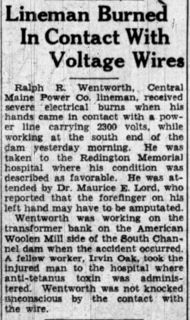
The accident was probably the one of 5 October 1941. The Morning Sentinel of the next day reported that a Central Maine Power lineman had been badly burned by a power line on the transformer bank at the South Channel dam in Skowhegan, and that "a fellow worker, Irvin Oak, took the injured man to the hospital." Likely
The award was the National Safety Council's, not the electric industry's own medal; Central Maine Power's first Edison Electric Institute medal came only in 1952. Confirmed The papers spelled his name Irvin, Oaks and Oakes.
About the evidence
The October 1941 report and the February 1942 award report differ on details: the award report says the accident happened "last summer" and that the injured man was knocked unconscious, and the two give different voltages. Both name the same men and the same dam, which is why the October accident is the probable match rather than a certain one. Three of the other February reports have since been read in follow-up research that is still being reviewed; the rest are known only by their headlines. The family's memory of the rescue is kept as a family tradition alongside the newspapers, which confirm its core.
Sources
- Morning Sentinel (Waterville, Maine), 24 February 1942, p. 12, "Irvin G. Oaks To Be Presented Safety Medal" (public clipping): www.newspapers.com/article/morning-sentinel-irvin-g-oaks-to-be-pres/206674242/
- Morning Sentinel, 6 October 1941, p. 9 (Newspapers.com, subscription): www.newspapers.com/image/854287913/
- Reports of 25-26 February 1942 in the Morning Sentinel, Bangor Commercial, Portland Evening Express, Kennebec Journal, Brunswick Times Record and Bangor Daily News (three read in follow-up research that is still being reviewed; the others known only by headline).
- Evening Express (Portland), 1925, marriage notice (clipping): www.newspapers.com/article/evening-express/143601223/
- EEI Bulletin, February 1953 (Internet Archive): archive.org/details/sim_edison-electric-institute-eei-bulletin_1953-02_21_2